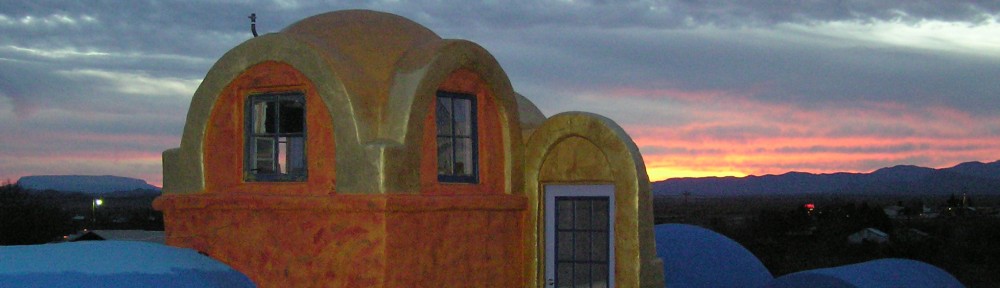
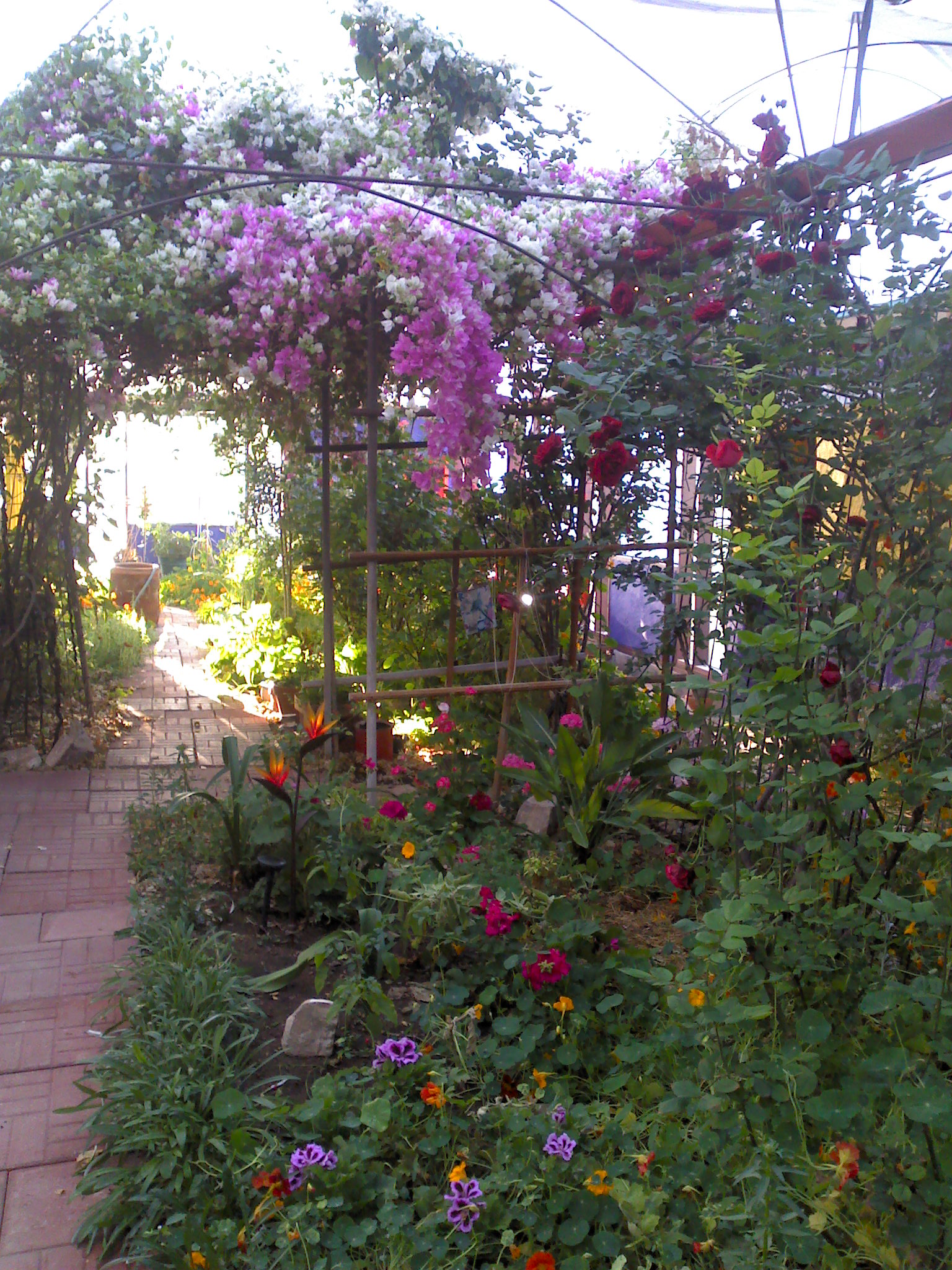
Eve’s Garden is an innovative Organic Bed & Breakfast and Ecology Resource Center, located in the beautiful high mountain desert of West Texas, at the gateway to Big Bend National Park, in Marathon, Texas. Eve’s Garden’s large indoor organic gardens are filled year-round with blooming roses, bougainvillea, and countless flowers. Our private, quiet, thoughtfully hand-built guest rooms open to a central covered courtyard with a pond and tea room. Our wish is to provide a comfortable Bed and Breakfast environment and a conversational forum to address issues regarding the ecology we live in.
A large amount of recycled content, paper adobe/fiber-cement buildings, high Mexican contemporary color treatments, and a focus on locally produced food, conspire to create an aura of thoughtfulness.
“Thoughtfulness” — this is our goal — to motivate you, our guests to pursue the projects you have in your minds, and recognize that you can make a difference.
—
NO BIG BEND WALL
FACT SHEET
Get up to speed on the proposed border wall situation in the Big Bend Region of Texas with these confirmed facts
This information is provided by nobigbendwall.org • Updated April 8, 2026
2026 TIMELINE
February 3
Plans for 175 miles of border wall in the Big Bend Sector are announced by Customs and Border Protection.
The planned wall route follows the Rio Grande river from Fort Quitman outside Sierra Blanca to Colorado
Canyon in Big Bend Ranch State Park.
February 10
First No Big Bend Wall Coalition meeting is held. Rapid mobilization across the region follows.
February 17
DHS waives 28 laws aimed at protecting environmental and cultural resources, including the Wild and Scenic
Rivers Act and the Native American Graves Protection and Repatriation Act.
February 18
The CBP border wall plan expands to include Big Bend National Park, Black Gap WMA, Seminole Canyon
State Park, Amistad National Recreation Area and the Wild & Scenic portion of the Rio Grande.
MARCH 5
The CBP map reverts back to “detection technology” Big Bend National Park sector after mounting bi-
partisan opposition and the firing of Kristi Noem, head of the DHS. Upstream, Big Bend Ranch State Park and
175 miles of private land are still slated for a physical border wall.
MARCH 23
Local CBP chief announces Big Bend Ranch State Park will also receive detection technology instead of a
steel wall.
MARCH 28
No public statements regarding map changes have been shared by any state or federal-level official. A steel
wall is planned upriver in June, affecting the towns of Redford, Presidio, Ruidosa, and Candelaria. Private
landowners are receiving letters from the CBP requesting access. Pollution and flooding from upstream
construction could flow downstream to towns, farms and public lands, including the parks.
BY THE NUMBERS
h 175 MILES of land along the Rio Grande river are currently slated for a steel border wall
h 342 miles of land are slated for “detection technology”
h $2.1B in contracts awarded for wall construction in Presidio and Hudspeth counties
h ~$17M: cost per mile of wall in Presidio and Hudspeth counties
h $4M: Presidio County annual budget; $22K median household income
COMMON SENSE BORDER SECURITY
In February, former DHS Secretary Kristi Noem waived 28 protectionary laws and fast-tracked the border wall
by saying the Big Bend Region is an “area of high illegal activity.” This is a verifiably false statement.
THESE ARE THE FACTS:
h The Big Bend sector is the largest in the United States, yet has the lowest number of migrant encounters.
h The Big Bend sector, the least populated part of the entire border, is the quietest of Border Patrol’s nine
U.S.-Mexico border sectors. 1.3% (3,096) of Border Patrol’s 237,538 migrant apprehensions in 2025 took
place in the sector, which incorporates over 25% (517) of the border’s 1,950 miles.
h The number of Big Bend sector encounters has steadily declined over the last 5 years.
h The remote and mountainous desert environment serves as a natural deterrent.
h Five regional sheriffs released a joint statement saying: “Based on decades of combined experience
working this terrain, we believe that construction of a continuous physical border wall in the Big Bend
region would not represent the most practical or strategic approach to border security in this area.”
POTENTIAL IMPACTS OF STEEL WALLS
h Indigenous Culture: The La Junta Archeological District around Presidio contains the remains of
pithouse villages dating back 800 years. These significant sites, in addition to countless Native American
graves and early historic cemeteries, would be permanently damaged by a wall.
h Flooding and Pollution: A 2026 study by Rio Grande International Center found that border walls and
buoys in Texas pose a threat to human life and property by increasing flooding intensity and capturing
debris that threatens bridges and drinking water.
h Dark Skies: Lights associated with walls and detection technology could endanger the Greater Big Bend
International Dark Sky Reserve, the largest dark sky area in the world.
h Wildlife: The Big Bend region functions as a north-south wildlife corridor and a habitat for many
endangered species, including birds, bats and fish. Steel bollard walls result in an 86% reduction in wildlife
crossings. Cutting off river access is especially dire in a desert environment.
h Tourism: Tourism to Big Bend National Park contributes $56.8 million to the local economy, which is
dependent on visitors.
DETECTION TECHNOLOGY
While “detection technology” may create less harm than a physical steel wall, there has been no public-facing
communication around what this technology entails. This technology may require significant road construction
for install and maintenance. Surveillance lighting could threaten dark skies and wildlife migration.
@NOBIGBENDWALL HOWDY@NOBIGBENDWALL.org nobigbendwall.org